
Have you ever wondered what buying groceries in Kenya was like back in 2006? Well, it often went something like this:
Long before sunrise, women traders were already on the move, often by 4 a.m. They travelled to central marketplaces such as Marikiti to collect produce delivered by different farmers, carefully selecting what they could afford before hurrying back to their stalls to prepare for the day’s sales. Their mornings were filled with uncertainty: deliveries could be late, supplies inconsistent, and produce sometimes arrived already spoiled. Outside, lorries offloaded sacks of tomatoes, potatoes, and maize at unpredictable hours, still streaked with mud from the farm — a reminder that supply was never guaranteed, and availability could shift at any moment.
By the time you arrived, the markets were fully alive.
As you stepped into the narrow aisles, you were met by traders calling out prices across crowded stalls; customers squeezing past one another, and air thick with dust, soil, and the sharp scent of onions and coriander. When you finally approached a stall —most often run by a woman trader, fondly known as Mama Mboga (in Kenya) and asked to buy groceries, her reply was usually a weary sigh: “I don’t have those groceries today. They weren’t available. Come back next week or try the other stall.” Frustrated, you would hurry to the next stall, hoping to find what you needed, only to face the same uncertain answer, the same wait, the same gamble with every purchase.
Behind that simple exchange lay challenges most never saw. Mama Mboga/ the woman trader had no phone to call suppliers, no reliable transport to bring produce in bulk, and no access to credit to buy ahead of demand. Growth depended entirely on whatever cash she could scrape together.
For thousands of informal small-scale produce traders across Kenya, most of them women , that was life: unpredictable, exhausting, and full of risk. Today, digital agriculture marketplaces are quietly rewriting that story.
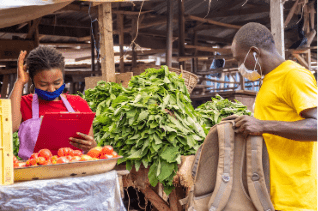
Caption: A woman trader checks her notepad as a male customer selects vegetables at her market stall.
A Persistent Gap in Financial Inclusion
Women run 56 percent of small-scale food trade in Kenya and across East Africa. Across Sub-Saharan Africa, an estimated 70 % of informal cross-border traders are women, moving fresh produce and groceries, often without access to formal finance (FAO). Yet despite their dominance, many traders struggle to secure loans, manage cash flow, or even know fair prices.
Without access to affordable credit or transparent pricing, many traders rely on informal lenders, often charging extremely high interest, just to keep their stalls stocked. These financial pressures ripple into households, affecting school fees, rent, and long-term stability.
Digital marketplaces offer a pathway out of that cycle by connecting traders directly to suppliers, logistics services, aggregating agricultural produce prices, and embedded financial tools through mobile platforms. Adoption does not happen automatically ,it requires trust, training, and incentives to make the shift worthwhile.
From Access to Action: Turning Digital Tools into Real Usage
To accelerate this transition, Mercy Corps Agrifin recently partnered with CoAmana to expand digital payments and Buy Now, Pay Later (BNPL) credit on the Amana Market platform among women traders.
The project, launched in August last year, combined technology with human support and behavioral design:
- Incentives: A five-tier system rewarding referrals, transactions, and ecosystem support
- Training: Field agents, call center staff, and market leaders guided traders’ step by step
- Gender-sensitive onboarding: Approaches designed to address women traders’ specific barriers
- Data tracking: Real-time dashboards measuring transactions, gender participation, and platform activity.
The results demonstrated how the right mix of digital tools and behavioral design can unlock participation:
- 5,000 digital transactions completed
- 60% women participation achieved
- Nearly 3,000 transactions conducted by women traders
Incentives played a critical role:
- Over 70% of new users completed their first transaction because of incentives
- More than 40% returned to transact again, showing sustained trust
This approach showed that technology alone is not enough. Digital tools only unlock potential when paired with incentives, guidance, and ongoing support, converting access into meaningful use. Embedded credit empowers women: BNPL enables timely purchases, smooths cash flow, and builds repayment discipline.
Hosea’s Story: Seeing the Shift from the Ground
When Mercy Corps Agrifin visited Kayole Market after the Amana Market engagement, Hosea Nyoike, Chairperson of Kayole Kona Market, offered a firsthand perspective:
“I’ve witnessed firsthand how the platform is changing traders’ lives. Each time I refer a trader, I receive KES 50 for onboarding them, and once they begin transacting, I earn KES 100 per transaction. With consistent activity, those commissions can grow to as much as KES 50,000 in a month – a clear sign of how active and engaged our market has become.
But the real impact goes beyond earnings. Before Coamana, many traders ,especially women , depended on informal lenders, often called shylocks, who charged high-interest loans and created constant stress. Today, traders have better options.
Coamana has helped us connect directly to reliable produce sources and coordinate deliveries across Kenya. We now order avocados from Githurai, potatoes from Wangige, and even products from Tanzania. Traders are guided through the platform step by step, and with transparent pricing, they can negotiate and plan their purchases with confidence. The referral codes also make it easy to track participation and reward those helping others join.
For women in particular, the change has been life changing. In my role, I also help resolve disputes at the magistrates’ office, and I’ve seen a noticeable drop in domestic conflicts linked to financial strain since Coamana arrived. Today, about 85% of Coamana users in Kayole Market are women, and many can now pay school fees, cover rent.” – Hosea Nyoike, Chairperson of Kayole Kona Market
Building the Future of Inclusive Agricultural Markets
Kenya’s digital agriculture market, now valued at about USD 1.2 billion, reflects growing connectivity, mobile adoption, and demand for efficient trade. For Mercy Corps AgriFin and its partners, the goal goes beyond digitizing transactions. It is about transforming everyday market realities, and the evidence shows it works.
Since inception, Mercy Corps AgriFin’s key pillars have been to strengthen digital agricultural services for farmers and market actors across the region. Working with partners, the program has connected users to buyers, bundled advisory services and training, enabled access to input credit and soil testing, and supported harvest and market linkages through one integrated digital platform. When digital tools are combined with practical support and incentives, adoption rises, transactions increase, and women gain greater control over their businesses, purchasing power, and financial planning. These lessons continue to shape newer collaborations, reinforcing that technology alone does not drive change, but ecosystems do.
Through our work as ecosystem enablers, a shopper can walk from stall to stall with certainty, because traders, especially, women traders can check prices on their phone, order produce from across the region, access credit when they need to, and restock before her shelves run empty. What once depended on chance now runs on information, access, and trust.
The outcomes are more positive, by traders gaining predictable income; the effects extend far beyond the market — strengthening households, stabilizing livelihoods, and supporting more reliable local food systems.
Digital platforms such as CoAmana are not just changing how trade happens in Kenya’s markets; they are actively expanding financial inclusion for women. Across thousands of market stalls, the story is no longer about waiting for produce to arrive.
It is about women traders planning, running stronger businesses, and shaping the future of Kenya’s food economy, one confident, connected transaction at a time.