
On the outskirts of Ndola, Zambia, children run in and out, curiosity brimming, while motorbikes hum past, delivering sacks of maize, vegetables, and cashew nuts to the city markets. The sun shines on a tight circle of women. Between them sits a small metal box, dented, scratched, but heavy with purpose. One woman unlocks it, another counts the cash aloud, while a third records the figures in a notebook worn thin from years of use. For these women, this simple box is more than a container. It is their bank, their insurance, their safety net, the centerpiece of a Village Savings and Loan Association (VSLA), a community-run financial system that predates digital platforms and formal banks.
These VSLAs are financially sophisticated, disciplined, and self-sustaining. They provide small loans, emergency support, and financial literacy in ways that formal institutions rarely replicate.
Village Savings Groups: Informal, Powerful, and Persistent
Village Savings and Loan Associations (VSLAs) have existed in Zambia since the early 1990s. Comprising 15 to 25 members, mostly women, these groups pool regular savings into a communal fund. Members borrow from the fund at low interest, repay loans, and support each other during emergencies. Over a full cycle, often a year, profits are distributed equitably.
They foster financial inclusion, social capital, and women’s empowerment, particularly in underserved areas. They operate with transparency and discipline, bypassing formal banks that are often unaffordable or physically inaccessible. For many rural households, the metal box represents trust, a tangible, visible, and socially enforced financial system.
The Gap- Building the Mutuals Model
However, while VSLAs are strong at savings and small loans, they remain structurally vulnerable to large shocks, serious illness, death, climate events, and income disruptions that exceed the capacity of group funds. In these moments, even well-managed savings groups struggle to provide adequate protection.
It is within this gap that Mercy Corps Agrifin and ACRE Africa positioned the mutual insurance pilot.
The initiative was not designed to replace savings groups or digitize them, but to strengthen their ability to absorb risk. Using a human-centered design approach, the project explored how a mutual microinsurance model could layer structured protection onto existing VSLA systems, preserving trust, routines, and governance while expanding resilience leveraging technology.
Mercy Corps AgriFin and ACRE Africa laid out critical groundwork towards piloting the mutual insurance project.
A Different Kind of Innovation
The project, which began last year, introduced a digital insurance product with a “mutuals” feature for market traders and members of Village Savings and Loan Associations (VSLAs) in Zambia. Designed to reflect the collective nature of savings groups, the model pools resources, shares risk and promotes transparency.
Supported by the DigiBima platform (ACRE product), the solution enables premium aggregation, streamlines claims processing, and provides visibility into fund usage, while allowing any surplus to be rolled over into future premium cycles.
The product covers four key risk areas:
- Last Expense / Permanent Total Disability (PTD)
- Hospitalization cash (including maternity cover)
- Seasonal climate risk insurance
- Funeral/Last expense.
Over the past year, the ACRE team piloted this approach by aggregating members’ premium contributions, managing claims payouts against key risks, and providing visibility into how premiums were used. Where surpluses existed, funds were either returned to members or rolled over into future premium cycles, reinforcing the principle of collective ownership rather than profit extraction.
Key achievements included:
- Successful design and rollout of a mutual microinsurance product tailored for VSLAs in Zambia
- Geographic coverage across Lusaka, Ndola, Chongwe, and Kitwe
- Training of 40Private Service Providers (PSPs), 35 of whom were women
- Engagement of 54 VSLAs, reaching 645 members
Despite this progress, uptake remained uneven. Adoption challenges, trust barriers, digital divide, behavioral dynamics, and operational frictions began to emerge.
However, the most valuable insights did not come from the product itself, but from listening. These realities prompted Mercy Corps AgriFin and ACRE to undertake field visits in January this year, to better understand the solution, refine it, and adapt it to the lived financial practices of communities.
During this visit, the team also shared the redesigned, more accessible insurance tiers with participants. Originally priced at 1,000 kwachas, the product had been redesigned into three new tiers to improve affordability:
- Gold: 600 kwachas
- Silver: 300 kwachas
- Bronze: 150 kwachas
In addition, ACRE’s Senior Manager of Programs, Lillian Waithaka, who led member training, highlighted that the product had been redesigned to cover up to six family members and include coverage for maternity, a revision from the version introduced last year. As members (from fish traders and vegetable sellers to charcoal vendors) and PSPs discussed the revised product, their feedback revealed not just the everyday risks they face, such as floods, power outages, illness, and funeral expenses, but also how they understood and navigated the product in practice.
Through these conversations, a richer picture emerged not just of the insurance itself, but of how it was perceived, adopted, and integrated into the financial routines of different communities, providing insights critical for making the product truly relevant and usable.
Three Towns. Three Truths.
Lusaka: Curiosity, Caution, and Cash Realities
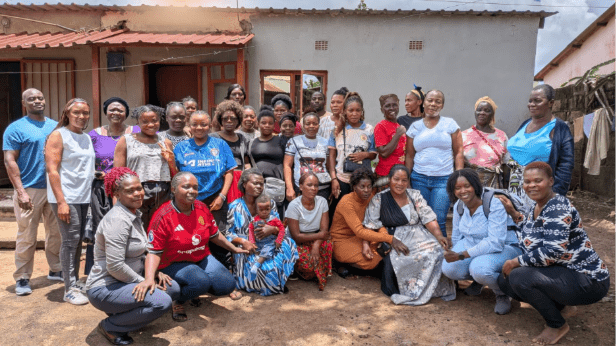
Caption: Members of a Lusaka savings group pose for a photo during the Mercy Corps Agrifin and ACRE field visit
Our first stop was Lusaka, the bustling capital of Zambia. As we arrived and joined a local VSLA meeting, it quickly became clear that this group gathered every week with remarkable regularity. During our conversation, the members welcomed the newly revised insurance tiers without hesitation, recognizing how the gold, silver, and bronze options made coverage more accessible.
However, only seven members in the 30-person group owned smartphones, and there was just one man in the group, the rest were women. Members shared the challenges they faced, particularly around accessibility for payments. USSD payment options would need to be greatly leveraged upon, and group leaders sometimes had to take buses to deposit funds in banks before uploading contributions to DigiBima, which delayed digital records.
In moments of financial stress, some members were tempted to withdraw money from the metal box before it even reached the platform. Yet, there was broad appreciation that the product was being adapted to their routines; the metal box remained central, and the digital system was seen not as a replacement, but as an added layer of security and support.
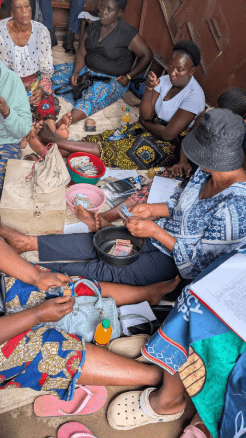
Caption: Women in the Kitwe Savings Groups counting cash received during Mercy Corps Agrifin and ACRE field visit beside them is a metal box
Kitwe: Discipline, Structure, and the Power of Social Trust
After an eight-hour drive north of Lusaka, we arrived in Kitwe on our second day. The journey gave us time to reflect on the insights from Lusaka, and we were curious to see how VSLAs in the Copperbelt approached savings, loans, and now the mutual insurance product.
At the meeting, Kitwe’s savings groups demonstrated remarkable financial discipline. Contributions were meticulously organized into savings, loans, social funds, and fines, with governance that was both collective and enforced internally by the group. Despite this strong structure, the adoption of DigiBima remained limited. Previous experiences with fraud had made some members wary of external or foreign institutions offering insurance products, having lost money in the past.
PSPs emphasized that members needed to feel a local ACRE presence to build trust, particularly given these past incidents. This reinforced the importance of visible, on-the-ground support to complement the digital platform.
Still, members expressed a willingness to pay for insurance, especially if they could leverage savings from their social fund. The group maintained a strict withdrawal process requiring two signatories, and members’ savings often exceeded 3,000 kwachas, with fines applied for missed repayments. During our visit, the revised insurance was received positively, providing flexible coverage aligned with their financial realities. The metal box remained central to their routines, with the digital system seen as a supportive layer rather than a replacement. Members highlighted practical challenges like timing of payments during farming seasons and coordinating deposits to the DigiBima platform, but the overall response showed cautious optimism.
Ndola: Understanding the Digibima Uptake from the PSPs perspective
Our final stop was Ndola, where the master PSPs work closely with savings groups across the district. During our visit, they shared insights into the low uptake of DigiBima and what was needed to increase trust and adoption.
PSPs explained that limited information and visibility meant product details were not easily accessible. They suggested that providing brochures and localized materials could help savings group leaders better promote the product. Additionally, they highlighted the importance of a strong local ACRE presence and support-leveraging its existing office in the area-particularly given that previous experiences with fraud have made some members wary of digital platforms linked to foreign companies.
Concerns around claims and processing times were also highlighted. For instance, if a group member lost a family member, there was uncertainty about how long the claims process would take, creating hesitation around adoption. Seasonality further complicated payments, as some members could not contribute during farming periods before receiving earnings.
Cash handling remains a core challenge. PSPs reported that when members saw contributions sitting in the metal box, some were tempted to use the funds for other purposes, highlighting the ongoing reliance on physical cash.
The process of transferring cash to the DigiBima platform required accompanying the leader to make the payment, which highlighted a gap in understanding digital versus cash transactions. The core learning here was that the issue was not reluctance to sign up, but rather members’ comfort with digital payments in a cash-dominant environment.
The team also observed that the claims process needed to be evaluated from multiple touchpoints. PSPs reported instances where the app froze or hung, adding further operational challenges. These insights emphasized the importance of listening to members and PSPs to refine DigiBima in ways that respect cash-based behaviors, build trust, and complement existing routines.
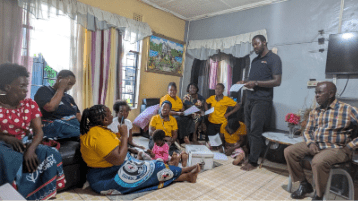
Caption: Mr. Milimo Hazele, consultant at Acre Africa meets with Agape Savings Group in Ndola during the Mercy Corps Agrifin and ACRE Mutual Insurance visit
Lessons Across Towns
Across Lusaka, Kitwe, and Ndola, these were the key challenges and learnings:
Key Challenges
- Strong reliance on cash as the primary and trusted transaction method
- Low familiarity with mobile money processes among members
- Failed transactions eroding trust in digital payments
- Network instability limiting consistent use of digital channels
Key Learnings
- PSPs require a structured and accessible complaints-handling mechanism. Establishing on-location ACRE offices with dedicated representatives will be critical for timely issue resolution and building trust with members.
- There is a clear need for a simple, user-friendly brochure/infopack to address member queries about the Digibima product, including clear guidance on the claims process. This material should be localized into different languages to improve understanding and accessibility.
- There is a need for increased training and awareness on the features of the Digibima application, particularly for feature phone users, including guidance on using USSD-based payment options.
- To accelerate product uptake, strategic partnerships with trusted fintechs for fund deposits will be essential to strengthen confidence in the system, particularly in Ndola, Lusaka, and Kitwe.
- There remains a significant need to build awareness and trust around digital credit within savings groups. This should be approached through phased engagement, grounded in an understanding of members’ cash-based behavioral norms and financial practices.
- Incentive structures are necessary to drive product adoption among savings groups, alongside facilitation and motivation mechanisms for PSPs to support sustained implementation and scale.
The Future in Their Hands
For Mercy Corps Agrifin and ACRE Africa, the path forward is clear: bridge tradition with innovation, ensuring protection, stability, and empowerment without disrupting the structures that have sustained these communities for decades.
For Zambia, financial resilience does not live in banks or mobile apps, it lives in circles of women, their careful accounting, and the humble metal box at the heart of it all.
Authored by :
- Emmanuel Makau, Senior Regional Technology and Data Manager, Mercy Corps Agrifin
- Michelle Njeri, Mercy Corps Agrifin