
By David Darkwa, Inclusive Financial Services Lead, Mercy Corps AgriFin
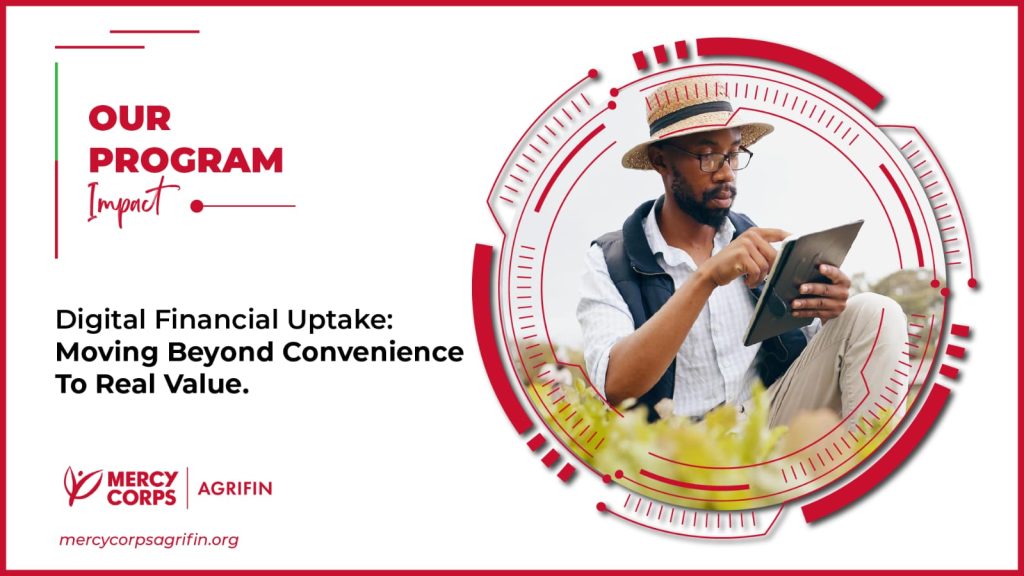
Digital financial services (DFS) have transformed the way individuals and businesses transact across emerging markets1. From mobile money to wallet-linked savings and QR-based payments, the infrastructure exists. The technology works. The benefits are evident.
Yet one persistent question remains: What truly drives uptake? Why is cash still king in many Sub-Saharan economies?
Widespread adoption of DFS is rarely just about access. It is also about incentives, trust, and long-term value – as perceived by the consumer.
The First-Use Barrier: The Carrot must be both Appetizing and Healthful to work
For many consumers, hesitation to adopt a new digital financial product is not about capability —it is about perceived benefit versus risk. Why switch payment methods? Why trust a new wallet? What if that first experience is poor and costly?
Balanced incentives can lower this barrier and encourage first time trial so that consumers debate the merits and demerits for themselves.
Cashbacks, fee rebates, and zero-rated transaction fees reduce the perceived cost of trying something new. They create a low-risk entry point and provide an immediate, tangible reward.
But incentives that only drive sign-ups without sustained engagement create inflated activation numbers and shallow adoption. True uptake goes beyond the first transaction. That balance can be achieved when providers structure rewards for repeated usage (such as loyalty points) and offer critical value-added services for target groups such as interest on wallet-linked savings to provide lasting value that encourage consumer retention. An appetizing carrot is not enough to sustain adoption; it must be wholesome too.
But what about the merchant?
Merchants: The Other Side of the Equation
Consumer incentives alone are not enough. Digital ecosystems thrive when merchants see value as well.
For merchants, adoption decisions are pragmatic. They evaluate:
- Merchant Discount Rates (MDR)
- Ease of QR code acceptance
- Liquidity and settlement timelines
- Access to working capital and associated terms and conditions
- Guarantees that reduce transaction risk
If digital payments simply compete on cost reduction without adding clear business value, it becomes a much harder sell for merchants. However, when DFS unlocks faster settlement, access to credit, improved record-keeping, and reduced cash-handling risks, the proposition becomes compelling.
The real opportunity lies in designing incentives that go beyond payments convenience to strengthen business resilience.
Balancing Activation with Retention
Another key challenge is determining the right combination of monetary and non-monetary incentives that balances activation with retention for both consumers and merchants.
Monetary incentives may drive early uptake.
Non-monetary incentives, such as recognition, transparency, customer support, souvenirs, paraphernalia and ecosystem integration, can sustain long-term usage.
Programs that prioritize only one side of the market often struggle. An emphasis on only monetary incentives is also unlikely to fully activate demand. Sustainable DFS ecosystems require a coordinated strategy that aligns consumer demand with merchant supply and balances monetary and non-monetary inducements.
Designing for Sustainable Growth
For digital financial services to achieve meaningful scale, providers and ecosystem partners must shift from short-term acquisition strategies to long-term value creation.
This means:
- Designing pricing structures that are affordable yet sustainable
- Ensuring interoperability and ease of use
- Building trust through transparency and consistent service delivery
- Embedding value-added services like credit, savings, insurance, and financial insights
Ultimately, DFS uptake is not about technology adoption, it is about behavioral change. And behavioral change happens when value is clear, risks are reduced, and incentives align across the ecosystem.
The future of digital finance will be defined not by how many accounts are opened, but by how deeply services are integrated into everyday economic life.
That integration is hinged on getting the incentive mix right.
Partnering for Inclusive Digital Ecosystems
At Mercy Corps AgriFin, we work with financial institutions, fintechs, mobile network operators, governments, and agribusinesses to design and scale digital financial solutions that work for low-income consumers and smallholder farmers.
Through market systems approaches, ecosystem partnerships, and data-driven insights, we support actors to:
- Design incentive structures that drive sustainable adoption
- Strengthen merchant ecosystems and last-mile distribution
- Build trust in digital financial products
- Embed financial services into agricultural value chains
If you are exploring how to increase DFS uptake for your solution while ensuring long-term ecosystem sustainability, we invite you to collaborate with us.
👉 Learn more about our work at www.mercycorpsagrifin.org
👉 Connect with our team to explore partnership opportunities.
Together, we can move digital finance beyond convenience and toward meaningful financial inclusion at scale.